The Dark Truth Behind Your "Healthy" Brown Bread: Is It Just Dyed White Bread?
Dietician Ankita Gupta Sehgal
12/15/20252 min read

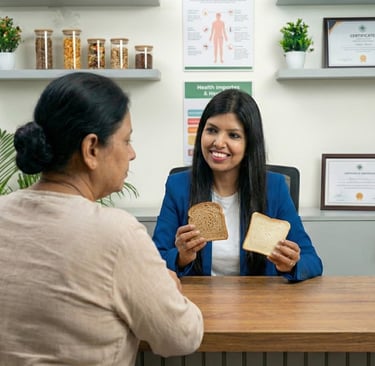
We have all been there. You decide to get healthy, so you make the switch. You walk down the supermarket aisle, bypass the white bread, and confidently grab a packet of "Brown Bread." You feel good about it. You feel like you’ve made a better choice for your gut and your waistline.
But what if I told you that the "healthy" brown bread in your basket is arguably nutritionally identical to the white bread you just rejected?
As a dietitian, one of the most common questions I get is, "Ankita, I’ve switched to brown bread, so why is my weight stuck?" The answer often lies in the fine print on the back of the packet. Let’s break down the biggest marketing myth in the bakery aisle.
The "Brown" Illusion: Color vs. Content
The biggest misconception we have is that Brown = Whole Wheat. This is not true.
In the world of commercial baking, "Brown Bread" is often just a fancy name for White Bread that has gone through a makeover. If you flip that packet over and read the ingredients, the first item listed is often Refined Wheat Flour (Maida)—the exact same ingredient used to make white bread.
So, where does the brown color come from? It’s not fiber. It’s not bran. It is usually Caramel Color (Class II Preservative / INS 150a) or molasses. Essentially, you are eating white bread that has been dyed brown to look healthier.
Brown Bread vs. White Bread: Spot the Difference
If you compare the nutrition labels of standard commercial white bread and standard commercial brown bread, you will be shocked:
Calories: Almost identical.
Sugar: Both often contain added sugar to activate yeast and improve taste.
Fiber: "Fake" brown bread has negligible fiber, just like white bread.
Glycemic Index: Both spike your blood sugar rapidly because they are both made of refined flour.
How to Be a Bread Detective (Check the Label!)
I don’t want you to fear bread, but I do want you to be an informed consumer. When buying bread, ignore the front of the packaging. Words like "Farm Fresh," "Healthy," or "Natural" are marketing terms, not nutritional facts.
Turn the packet around and look for this:
The First Ingredient: It must say "Whole Wheat Flour" or "Atta" (at least 51% or more). If it says "Wheat Flour" (which is often just Maida) or "Refined Wheat Flour," put it back.
Percentage Matter: Genuine healthy breads will list "100% Whole Wheat." If the packet says "Brown Bread," but the ingredients show 50% Maida and 50% Atta, you are still compromising.
Fibre Content: A real whole grain bread should have at least 2-3 grams of fiber per slice.
The Better Alternative? (Hint: It’s in Your Kitchen)
If you are struggling to find genuine 100% whole wheat bread (and let's be honest, they can be dry and expensive), remember the best alternative that is already in your kitchen: The Roti.
A homemade Roti is:
100% Whole Wheat (Atta).
Zero preservatives.
Zero added sugar.
Zero artificial colors.
Conclusion
Don't judge a bread by its color. The "Brown" in brown bread is often just a tan provided by caramel coloring. If you enjoy bread, look for 100% Whole Wheat on the label, or better yet, stick to home-cooked meals where you control the ingredients.
Confused about which carb source is right for your body type? Let’s build a diet plan that fits your lifestyle - no fake labels included.
Have a Question? Fill up the form below


Contact
Dietician Ankita Gupta Sehgal is one of India's leading dieticians specialising in PCOS reversal, sustainable weight loss, thyroid management, gut health, and women's hormonal nutrition. Based in Delhi with 16+ years of clinical experience, she has helped thousands of women across India, USA, UK, UAE, and Canada transform their health using personalised, science-backed Indian diet plans - no crash diets, no supplements, just real food.
info@nutritionmatters.co.in
+91-9873974659
© 2025. All rights reserved.
Call